Overview of Sensorimotor Stickies
A reconfigurable platform for closed-loop on-body vibrotactile feedback in sensorimotor training
Sensorimotor Stickies is a wearable platform designed to support rapid prototyping of closed-loop, on-body sensing and feedback applications. The platform consists of:
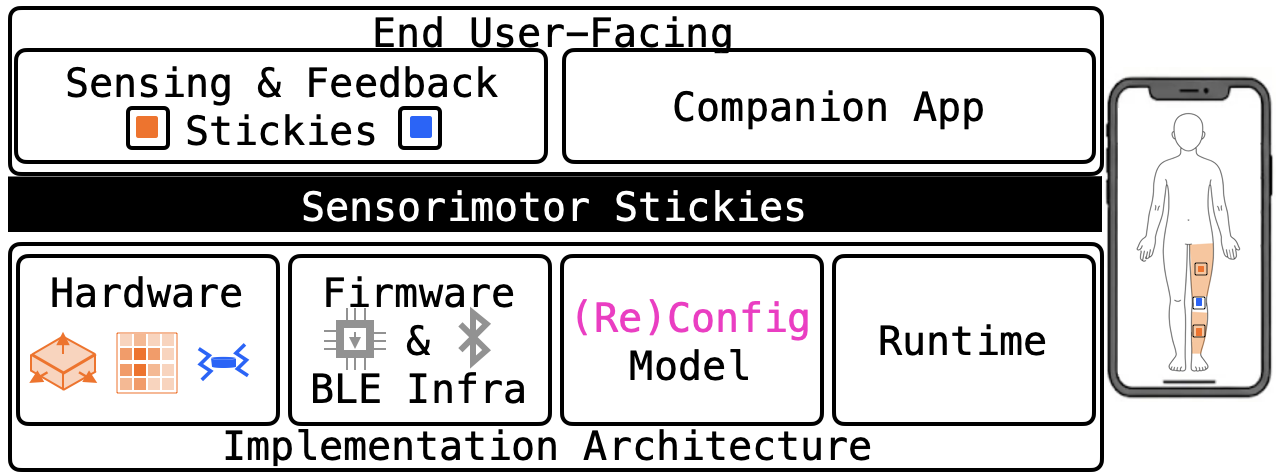
- sensing and feedback stickies that can be taped onto the body, and
- an Android companion app that communicates with and configures stickies
The platform is implemented via:
- a physical wearable layer of miniaturized, low-power adhesive sensing and feedback modules designed for unobtrusive wear during active movement,
- a reusable embedded layer with Bluetooth Low Energy (BLE) infrastructure for raw sensor streaming and motor control across tasks without firmware rewrites, and
- a body-centered configuration model and runtime for setup, calibration, feedback authoring, and closed-loop execution during use.
See the preview video below or watch the longer video with more examples and details.
Platform Capabilities
The platform can be used at three levels, depending on how much of it you want to reuse versus build yourself. All three start from the same physical stickies hardware.
Stickies + Companion App
Use the full platform exactly as implemented, controlled entirely through the companion app: no code, no firmware changes. See Use Stickies for detailed instructions.
Sense the body-state metrics that matter for your task
Via the 6-axis IMUs and the optional tactile patch in the sensing stickies, the app supports tracking:
- Joint metrics (2 sensing stickies on adjacent body segments) — supports 1-DoF and 2-DoF joint angles and optional angular velocity. 3-DoF joints' flexion can be tracked by treating them as a 1-DoF joint, with limited performance.
- Segment metrics (1 sensing sticky) — a single segment's orientation (pitch, roll) and motion (angular velocity, linear acceleration).
- Tactile metrics (tactile extension patch) — contact presence, total and peak pressure, contact area, and center-of-pressure location.
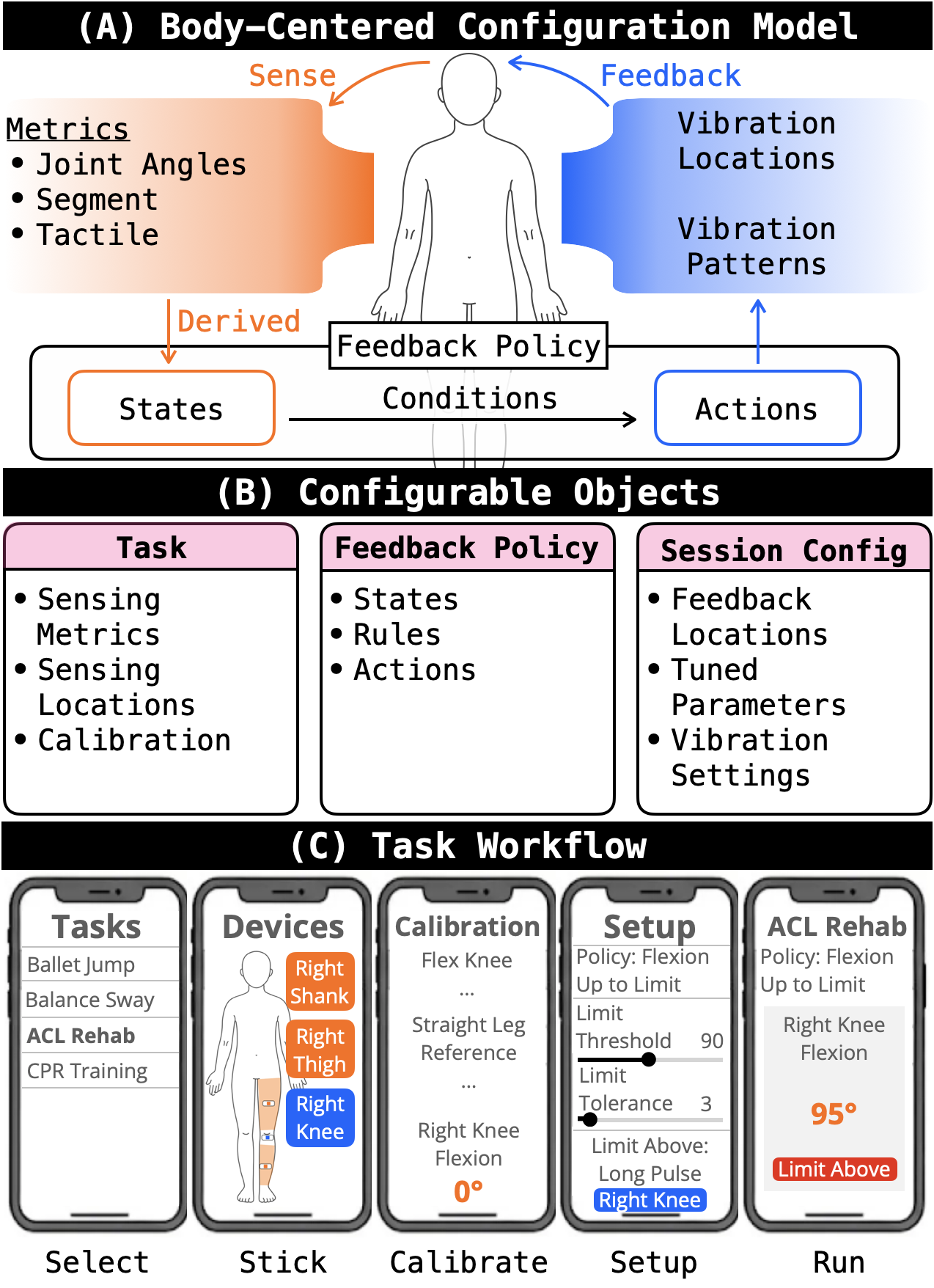
Get real-time vibrotactile feedback
Depending on the policies, vibrotactile feedback can serve as warnings, rewards, confirmations, etc. The app supports reconfiguring:
- Feedback location — which feedback sticky (and so where on the body) renders the cue.
- Trigger condition — the sensed state that fires it, e.g., "flexion crosses 60°" or "hand center-of-pressure drifts left."
- Vibration pattern — pulse duration, repetition count, and intensity, e.g., a single long pulse versus a triple tap.
Example Applications
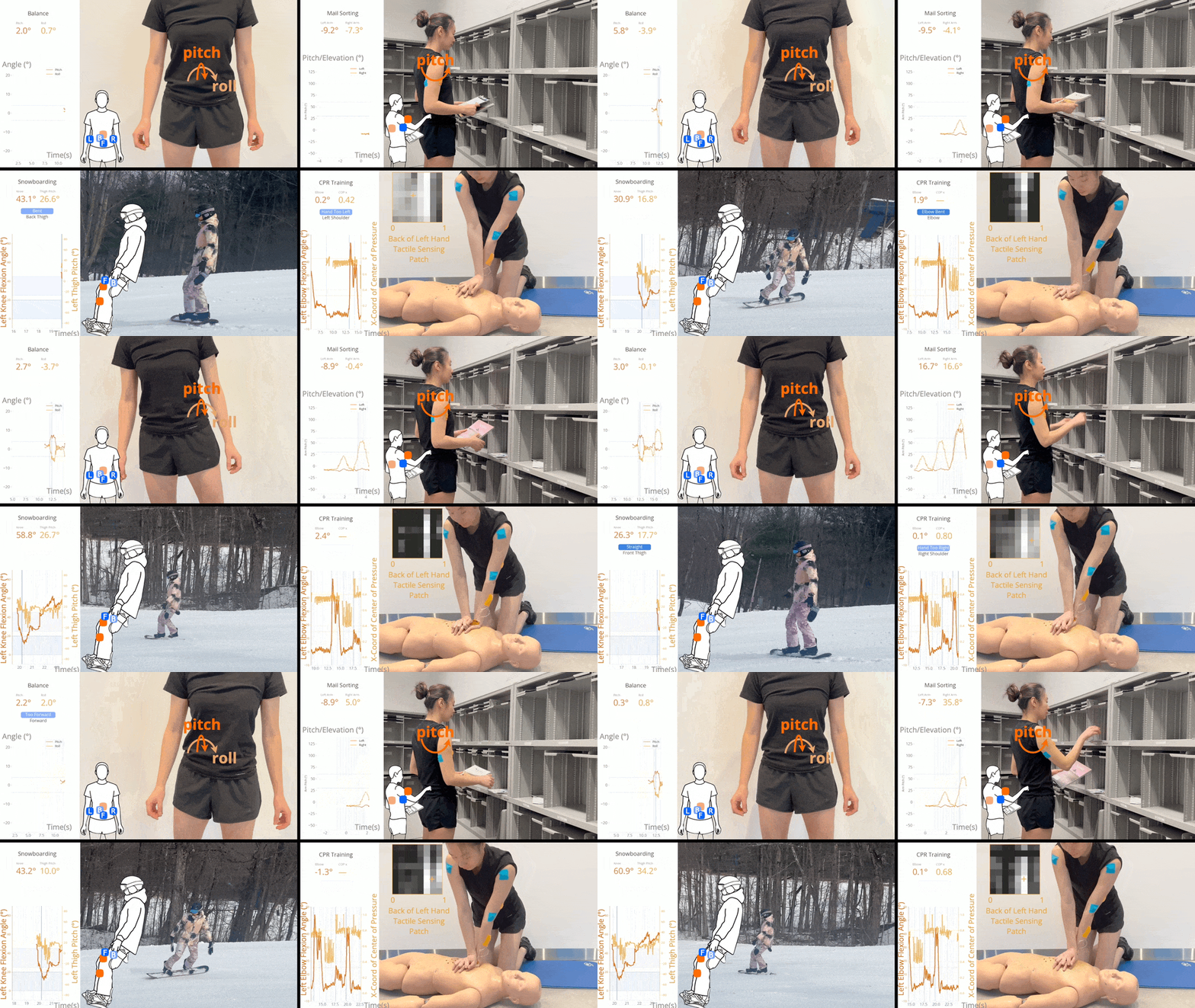
The following tasks are authored using the companion app:
- Balance training — cueing trunk sway during standing
- Ergonomics — warning on sustained poor arm elevation while sorting mail
- Snowboarding — cueing knee bend hands-free during a full run
- CPR compression — cueing elbow bend and hand position during chest compressions
Stickies + Your Own Control Layer
Keep the prebuilt sensing/feedback firmware, but replace the companion app with your own software. Stream raw IMU and tactile data and send motor commands directly over BLE — useful if you want a custom UI, need to integrate stickies into existing research or clinical software, or want control logic beyond the companion app's task/policy model. See BLE API Reference for the GATT services and commands to build against, and Reference Implementations for example apps built on top of it.
Stickies + Your Own Firmware & Control Layer
Program the sensing/feedback firmware itself to support a new sensor using the expansion port, change on-device processing, or expose a service the current BLE API doesn't, and pair it with your own control software. See our schematics.
Where to Go Next
- Use Stickies — you have physical Stickies: flash firmware, attach them to the body, connect to the companion app, and run a session.
- Get Stickies — get physical Stickies: PCB design and ordering assembled boards.
- Develop Stickies — build your own software against the exposed BLE API.
- Troubleshooting — common issues and fixes.